

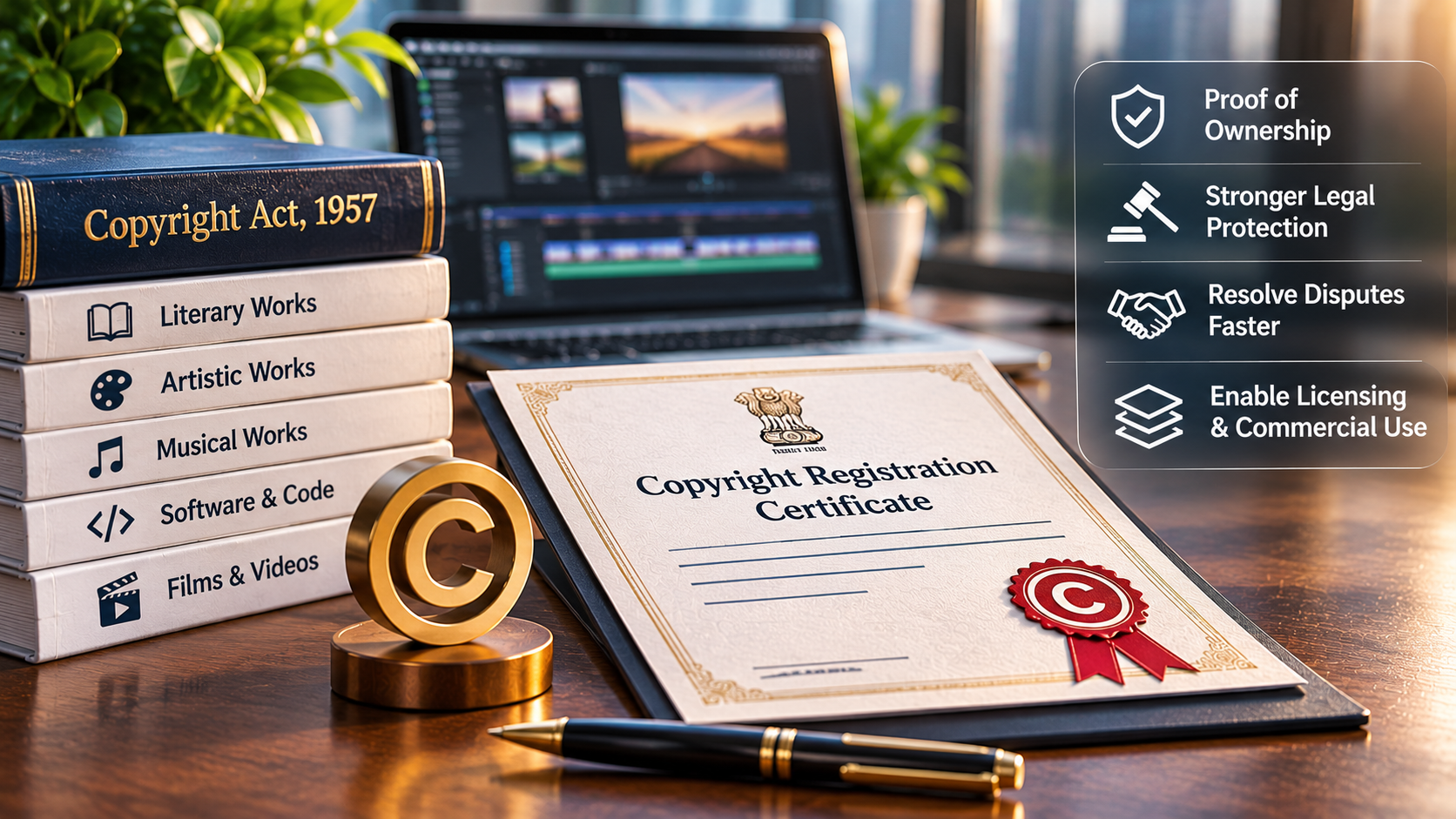
This is the first question anyone raises when copyright registration comes up, and it is a fair one.
Under the Copyright Act, 1957, protection exists from the moment an original work is created and fixed in a tangible form. You do not file anything. You do not pay anything. The moment you write the article, record the track, design the layout or commit the code, it is protected.
So if the law already protects you, what exactly are you paying for when you register?
The answer is not protection. It is proof. And the difference between the two only becomes visible at the exact moment it matters most.
What Automatic Protection Actually Gives You
Automatic copyright gives you rights. The right to reproduce the work, to publish it, to adapt it, to perform it publicly, and to authorise others to do any of those things.
What it does not give you is evidence.
If someone copies your work and you decide to act, the first thing you have to establish is not that copying occurred. It is that the work was yours, and that it existed in your hands before it appeared in theirs. Rights are meaningless until ownership is established, and establishing ownership is entirely your burden.
This is where most people discover the gap.
What You Would Actually Produce as Proof
Ask yourself what you would place in front of a court tomorrow to prove a piece of work is yours.
A file creation date. Metadata is editable. Any competent person can alter it in under a minute, and the other side will point this out.
A social media post. It establishes that you published something on a date. It does not establish authorship, and platforms routinely strip metadata on upload.
An email to yourself. Better than nothing, but easily characterised as self serving. You controlled both ends of that email.
A client invoice. It shows you were paid for work. It does not show which work, or that you created rather than procured it.
Witness testimony. Colleagues who saw you create it. Available, but slow, expensive and contestable.
Each of these can be argued against. None of them settles the question quickly, which matters because in most disputes the cost is not the final outcome. It is the eighteen months spent arguing about something that should have taken one hearing.
What Registration Changes
A registration certificate issued by the Copyright Office is official documentation that you claimed ownership of a specific work on a specific date, before any dispute arose.
Three practical consequences follow.
The burden shifts. Instead of you proving ownership, the other side has to displace your registration. That is a materially harder position to argue from, and it changes the economics of the dispute immediately.
Most disputes end before court. A cease and desist letter accompanied by a registration certificate is treated very differently from one that simply asserts ownership. A large share of infringement matters resolve at this stage precisely because the recipient can see that the other side is documented and the fight is not worth having.
Commercial transactions become possible. Licensing, assignment, platform claims and due diligence all require demonstrable ownership. An investor examining your IP wants a certificate, not an explanation. A publisher or distributor asking you to warrant ownership wants something they can rely on.
Our copyright registration services exist for this reason: not because the law requires registration, but because enforcement without it is slow, expensive and uncertain.
What Can Be Registered
Copyright covers a wider range than most people assume.
Literary works. Articles, books, scripts, manuals, training material, website content. Software source code also falls into this category under Indian law, which surprises many developers.
Artistic works. Illustrations, photographs, paintings, graphic design, logos as artistic works, architectural drawings.
Musical works. The composition itself, separate from any recording of it.
Sound recordings. The recording as a distinct work from the underlying composition.
Cinematograph films. Video content, advertisements, films, and increasingly, substantial digital video output.
Dramatic works. Scripts, choreography and stage direction.
What copyright does not cover is equally important. Ideas are not protected, only their expression. Facts and data are not protected, though a particular arrangement of them may be. Titles, names, slogans and short phrases are generally not protected by copyright, which is why brand identifiers go through trademark registration instead. Functional inventions require patent registration, and the visual appearance of a manufactured product falls under design registration.
The Businesses That Need This Most
Certain categories carry disproportionate exposure.
Software companies. Code is the entire asset. In an ownership dispute with a departing developer, a contractor, or a competitor, documentation is the whole case.
Agencies and studios. Design, content and creative output produced continuously, frequently reused by clients beyond the agreed scope, and almost never documented.
Content and media businesses. Volume is high, copying is routine, and enforcement at scale is only viable with registration in place.
Training and education providers. Course material and curriculum represent years of investment and are copied constantly.
Product businesses with distinctive packaging. Artwork and label design are copied by competitors far more often than the product itself.
Photographers and videographers. Unauthorised commercial use is the normal operating condition, not the exception.
When Ownership Is Not What You Assume
This is the part that catches businesses out, and it has nothing to do with outside infringers.
Work produced by employees generally vests with the employer where it is created in the course of employment, but the position is cleaner when employment contracts contain an explicit IP assignment clause. Many do not.
Work produced by contractors and freelancers does not automatically vest with the business that commissioned it. The default position often leaves copyright with the creator unless there is a written assignment. Agencies, developers, designers and photographers engaged without proper contracts may still own work your business believes it owns.
Work produced by founders before incorporation belongs to the individual, not the company, unless it has been formally assigned. This is identified routinely during due diligence and is awkward to resolve after a falling out.
These are contract problems, not copyright problems, which is why registration and documentation work best together. Our legal assistance team handles employment contracts, contractor agreements and IP assignment deeds for exactly this reason.
What to Do If Someone Has Already Copied Your Work
If it has already happened, sequence matters.
Document the infringement immediately. Screenshots with visible dates, archived page captures, downloaded copies, URLs. Infringing material disappears quickly once the other side becomes aware, and a claim without evidence of the original infringement is difficult to sustain.
Establish your own timeline. Gather everything that evidences when your work was created and first published. Drafts, correspondence, publication records, invoices, anything with an independent date.
Assess the commercial reality. Is this a small operator who will stop on request, or a competitor deriving meaningful revenue from your work? The appropriate response differs substantially, and not every infringement justifies formal action.
Send a cease and desist. Most matters resolve here, particularly where the other side can see you are documented.
Use platform takedown mechanisms. Where the infringement sits on a marketplace, search engine or social platform, their notice procedures are faster and cheaper than any legal route. Most require proof of ownership, which is where registration does immediate practical work.
Escalate if necessary. Civil remedies include injunction, damages and accounts of profits. Criminal provisions also exist under the Act for certain infringements.
The Honest Cost Comparison
Copyright registration is inexpensive relative to almost any other protective step a business takes. Government fees are modest and vary by work type.
Enforcement without registration is not expensive in itself. It is expensive in time, in uncertainty, and in the likelihood that a matter which should have been settled with one letter instead becomes a prolonged argument about whether the work was yours at all.
The asymmetry is the entire argument. The cost of registering is small and known. The cost of not registering is unknown, and only becomes visible when you are already in a position where you need it and cannot get it retroactively.
Where This Sits in Your Wider IP Position
Most businesses need more than one form of protection, and the combinations are fairly predictable.
A software product typically needs copyright on the code, a trademark on the product name, and contracts assigning developer output. A consumer brand typically needs a trademark on the name and logo, copyright on packaging artwork and marketing content, and design registration on distinctive product form. A content business typically needs copyright across its output and a trademark on its publication identity.
Where an audio identifier is central to the brand, sound mark registration applies. Where a product is tied to its region of origin, geographical indications may be relevant.
Businesses addressing intellectual property often find statutory compliance has drifted in parallel, since both get deferred for identical reasons. A regulatory compliance audit surfaces those gaps before an investor or regulator does.
The Short Version
Copyright protects you automatically. Registration proves it.
In a dispute, proof is what determines whether the matter takes one letter or two years. That is the whole of the difference, and it is worth considerably more than the registration costs.
ACATL has handled copyright, trademark and design registrations for over twenty three years, with more than a thousand clients protected across India. If you want to understand what in your business should be registered and in what order, contact our team.